
The start of a new year provides fodder for news outlets. At this time of year, newspapers and televised news programs will feature stories about getting into shape, losing weight, improving one’s health, and the quirky new laws going into effect. Among the early news staples, you’re virtually guaranteed to read or see features identifying the go-to travel destinations in the coming year. Thus, this week I eagerly reviewed an article in The New York Times describing the “52 Places to Go in 2026.”
Part of the fun of such articles and reports is getting travel news about places that you’ve dreamt of visiting, or, even better, learning about entirely novel destinations that weren’t previously on your travel radar. Me? I get smug satisfaction when I can crow, “been there, done that” about any travel destination hyped as the next big, must-do thing.
So, as I perused the Times’ list, I made a mental checklist of the 2026 recommended destinations I have already visited. Big Sur? Check. Dominican Republic? Check. Ditto for Ecuador…parts of Route 66…, L.A., naturally.
This year, the Times also recommends seeing the Canadian Rockies by train. Although I’ve never traveled the “Via Canadian” train, Lee and I were fortunate to see this magnificent beast during its whistle stop in Jasper, Alberta, Canada, as part of its maiden voyage across that country. Shiny and luxurious, indeed, but also obviously beyond our disposable income at the time, we would have to imagine what such a cross-country adventure might entail.
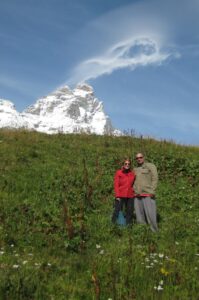
Another of The Times’ recommendations for 2026 is Breuil-Cervinia, which marks the Italian side of the famous Matterhorn. Here, Lee and I pose for a quick photo-op during our visit to this magical region during the Summer of 2013. Lee’s nephew, Brad, a sommelier by profession, took this photograph. Brad, his lovely Italian bride, Anna, and their two beautiful daughters, who live nearby in a picturesque village, were our gracious hosts.
***
Now, in general, I don’t begrudge fellow travelers who walk the same paths I’ve taken. However, when I saw that The Times had recommended travelers “[s]kip the crowds and enjoy the waves and wild beaches” of the Osa Peninsula, Costa Rica, I felt violated.
When Lee and I visited the place in 1997, half the fun was getting there. From the capital of San Jose, we hopped onto a small prop plane with fifteen or twenty other passengers for a short flight over towering, green mountains forming a spine that runs north-south through the middle of the country, before settling in over miles of impenetrable jungle terrain. One of the remarkable features of this flight, which was pre-9/11, was the sight of a uniformed pilot and co-pilot sitting in an open cockpit, only a few feet from our seats.
I could feel us descending into the emerald green when, quite suddenly, the jungle broke, and we observed a field or farm of some kind off in the distance. This turned out to be our landing strip. As we approached, I spotted a plump Costa Rican woman standing on a dirt runway, waving flags to direct us.
From there, we were whisked away in a van through the jungle along a narrow, dirt road that ended at a small pier on a wide, brown river. Here, we boarded a small watercraft for the next leg of our journey. Along the river, there were constant bird calls, and large birds, including colorful macaws, fluttered in and out of the towering tree canopy. The sound of our boat’s motor startled a large cayman lazing in the sand, which quietly slid into the water.
Ahead, we could see the blue Pacific Ocean. Our small boat entered it, turning south, running parallel for several miles past empty beaches fronting an elevated expanse of green jungle. There were few signs of any human activity, let alone human civilization.
For a moment, I thought of “Jurassic Park,” a movie that had been released only a few years earlier. I imagined what it would be like to witness a dinosaur emerging from this dense jungle.
***
Now, as I continued to read about the famous chef, whose “jungle set trattoria,” and “farm-to-table,” is setting a new gastronomic standard, the “new boutique hotel that hosts wellness retreats,” and the advent of direct flights that “make it all more accessible,” I felt increasingly glum.
For Lee and me, the Osa Peninsula had been a special place. It was not the place where Lee and I fell in love, mind you. However, it was the place where we recognized that we wanted to spend our lives together. Now, it sounds as if that special place is disappearing, if it’s not already gone.