
The first weekend of the professional football season is now complete. As has been the case for far too many seasons, my team melted down just when it mattered most, coming up short against a hated rival.
In the immediate aftermath, I halfheartedly listen to the angry, postgame blowback of fans on sports radio, which quickly fades into white noise. Such complaining is more than a local custom. Here, it feels like a tradition. Savvy radio personalities, bloggers, and writers understand that negative fan reaction can generate a bigger audience, more “clicks” or “hits.” It doesn’t take but a couple of these complaining callers for me to recognize I am not alone in feeling frustrated by my team’s latest sorry performance. The mutterings of spectators at the Colosseum in the film Gladiator – delirious, raising goblets, calling for blood — come to mind. Are you not entertained?
***
I make no apologies for being an avid fan or a player of sports. I take after my parents.
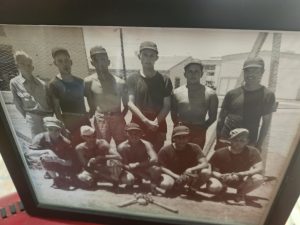
Apart from baseball, my father loved to play touch (flag) football on the Midway. Many years later, I would play in touch football games there.
I never saw him on ice skates, but as a kid, older family members or my parents’ friends would sometimes regale me with his ice escapades as a young speed skater. In her youth, Mom was a competitive swimmer and diver. Every Summer, starting at the age of six, they encouraged my participation in a boys’ sports camp.
***
Sports are in my blood. I am my parents’ son.
My parents were fans of specific teams, though not necessarily the same teams. The teams I adopted for myself growing up were also their teams. The teams I cheer for today are the same ones I adopted as a kid. My allegiances to them never waver.
Team loyalty was an ingrained concept running deep in my mother. However, as between them, my dad often tried to appear detached and neutral. If he held a deeper emotional attachment, he kept it to himself.
For a long time, my mother’s love of sports, especially for her chosen teams, helped her cope with creeping age, assorted illnesses, and compromising physical conditions. Still, they seldom won.
My mother’s favorite baseball team did experience a few winning years when it played an exciting brand of baseball. Mom passed when she was eighty-five. Remarkably, her baseball team never won a single championship in her lifetime.
A few years after Mom passed, her favorite baseball team finally won its championship. I was already a middle-aged man when this occurred. Winning the World Series remains an emotional, thrilling, and happy memory for many, including yours truly.
Relatively early in their championship run, I ventured to a tavern that featured multiple, strategically located, large-screen televisions and sold pricey beer, to celebrate with other fans in this glorious event. I recall the first game was a nail-biter, which our team won in extra innings. It was a sudden and dramatic ending; some fans later would say they were blessed to have witnessed a miracle.
This public occasion proved to be the exception as I quickly discovered that I preferred watching these games by myself. Indeed, more sensational games followed. After it was over, after my team had at long last won its championship, despite my elation, a small part of me felt melancholy. With a tear in my eye, I recalled my mother and other fans of our team who never got to experience the exhilaration of being the best.
***
Now, in the aftermath of my football team’s latest loss, I think about how much better it would feel to be the winner. This is the moment when the depressing thought that I might never celebrate another winner lands with a hard thud.